
How AI Agents Are Changing Customer Support for Modern Teams
Customer expectations have changed. They want fast, accurate answers — not after hours, not “within 24 hours,” but now.
Yet inside most teams, support still relies on people manually reading every message, sorting every request, rewriting the same replies, updating multiple systems, and escalating issues by hand. During busy times, teams get overwhelmed. Messages pile up. Response times slow down. Small issues become big frustrations.
The problem isn’t the people.
The problem is the system.
Traditional support workflows were never designed for the volume or speed modern businesses face. That’s why AI agents are becoming the new foundation of customer support — not to replace humans, but to remove the repetitive load that slows them down.
In this guide, we’ll explore how AI agents actually work, what they can (and cannot) do, and why modern teams are adopting them faster
What AI Agents Actually Are (Explained Simply)
AI agents are not “robots” or futuristic tech.
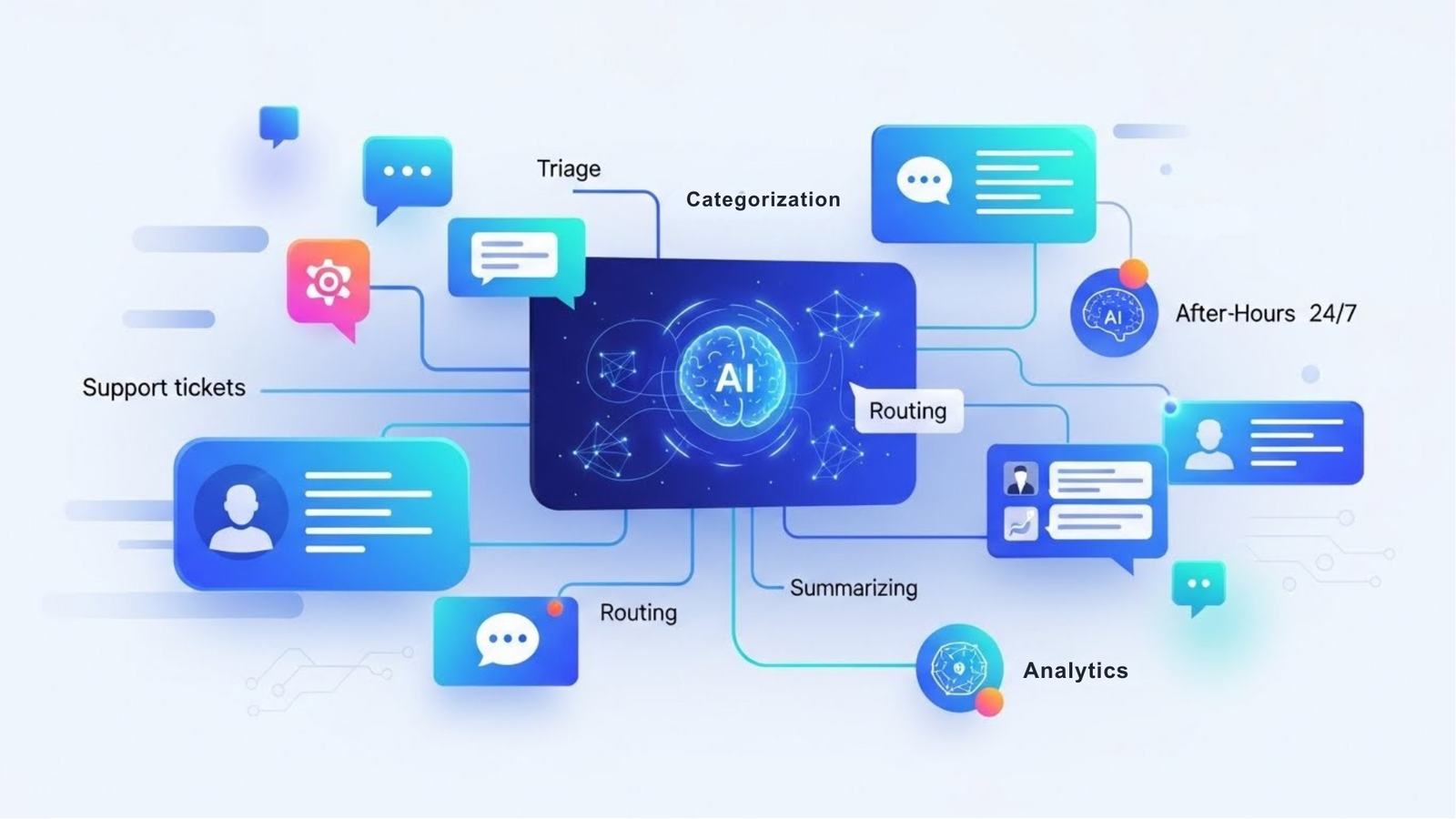
They are intelligent automated assistants that:
- understand messages
- detect intent and urgency
- categorize issues
- extract key information
- route messages to the right place
- trigger actions in your tools
- support your team with summaries and next steps
They work in the background, 24/7, without needing breaks — but they operate within clear rules and boundaries.
A typical AI support agent workflow looks like this:
Customer message → AI understands it → identifies issue → classifies it → takes action (reply, route, summarize, escalate).
They don’t replace your human support team.
They give them superpowers.
At Sync Genie, we design AI agents that run quietly behind the scenes, creating clarity and structure for support workflows without adding technical complexity.
The Limitations of Traditional Support Systems
Before we look at how AI agents improve support, it’s important to understand the problems they’re solving.
Most support teams struggle because their systems require humans to do everything manually.
Common friction points:
- Manual triage
Support agents spend too much time reading messages just to understand what category they fit into.
- Repeated questions
Teams waste hours replying to the same basic queries over and over.
- Missed priorities
Important or urgent requests often get buried in inboxes or ticket queues.
- Overload during peak times
When message volume spikes, teams fall behind quickly.
- Inconsistent responses
Different agents give different answers, leading to confusion and reduced trust.
- High operational cost
Simple tasks that could be automated still require human attention.
AI agents remove this load — they handle the “sorting, routing, replying, summarizing, and reminding” so humans can handle the actual customer experience.
How AI Agents Are Transforming Customer Support (7 Key Shifts)
AI agents aren’t replacing support teams.
They are changing how support operates — making it faster, smarter, and more scalable.
Here are the seven biggest shifts happening right now:
1. Instant Triage & Categorization
AI reads every incoming message and identifies:
- topic (billing, tech issue, refund…)
- intent (“I need help”, “I want to cancel”, “This is urgent”)
- required action
- priority level
AI reads every incoming message and identifies:
2. Faster Response Times
For common questions, AI agents can generate:
- acknowledgement messages
- personalized answers
- next-step guidance
For complex issues, AI prepares the message for the human agent, so they respond faster with full context.
The result?
Support waits shrink dramatically.
3. Reduced Support Costs
When AI handles:
- sorting
- routing
- repetitive replies
- information gathering
- after-hours messages
…human agents focus only on the conversations that actually require human attention.
This eliminates unnecessary workload without needing to hire more staff.
4. Smarter Routing Across Teams
Instead of every message landing in the same inbox, AI agents ensure:
- billing questions go to finance
- payment issues go to accounts
- technical bugs go to engineering
- onboarding questions go to customer success
- cancellations go to retention
This improves clarity, speed, and efficiency across departments.
5. Accurate Summaries for Agents
Not every message needs to be read line-by-line anymore.
AI agents generate short summaries such as:
- “Customer experiencing login error; tried password reset; still failing.”
- “User wants to change their plan; billing attached.”
- “Priority: customer frustrated after failed payment.”
Agents act faster because they start with clarity, not confusion.
6. 24/7 Availability
AI agents don’t sleep.
They don’t wait for the next business day.
They don’t get overwhelmed during peak hours.
They handle:
- after-hours inquiries
- holiday messages
- global customers across time zones
- weekend requests
By morning, the human team arrives to an organized inbox instead of a mountain of chaos.
7. Fewer Mistakes + More Consistency
AI follows rules.
AI follows structure.
AI doesn’t forget.
This results in:
- consistent replies
- zero missed tickets
- correct categorization
- fewer manual errors
- predictable workflows
Customers experience smoother, more reliable support — every single time.
Real-World AI Agent Workflows (Practical Examples)
Here are the types of workflows AI agents run inside modern teams:
1. AI Intake & Auto-Reply
AI reads an incoming message and responds with:
- a personalized acknowledgement
- a request for missing information (order ID, screenshots, etc.)
- estimated response times
This sets expectations instantly.
2. AI Support Triage
AI assigns the issue to the right department instantly.
This prevents:
- over-cluttered inboxes
- long manual sorting
- agents working outside their role
3. Summary Creation
Long emails and chat threads become:
- clear summaries
- next steps
- identified tasks
- reminders or follow-ups
This saves support agents significant mental load.
4. Escalation Rules
AI detects frustration, urgency, or risk and alerts the right manager.
This prevents small problems from becoming big issues.
5. After-Hours Support
AI agents collect information, answer FAQs, and create structured tickets for the next morning.
Customers feel heard — even outside business hours.
These workflows replace repetitive work, not people.
Human agents still handle empathy, complex conversations, and nuanced decision-making.
What AI Agents Can’t Do (And Why That’s a Good Thing)
It’s important to clarify what AI agents don’t replace.
AI agents cannot:
- handle emotionally sensitive conversations
- make financial decisions
- override a human’s judgment
- talk customers through complex troubleshooting
- decide refunds or special exceptions
- access restricted systems without permissions
Why this matters:
Humans are still the center of customer support.
AI simply removes the heavy lifting so people can do the work that only people can do.
How to Introduce AI Agents into Your Support Workflow
Implementing AI support doesn’t need to be complicated.
The most effective teams follow this step-by-step approach:
1. Identify repeated questions and patterns
Look at support tickets from the last 30–60 days and note what repeats.
2. Define categories and escalation rules
Clear structure = better AI accuracy.
3. Connect your existing tools
Helpdesks, CRMs, Slack, email, WhatsApp — AI thrives on connected environments.
4. Add AI intelligence (classification, intent, tone)
This is where your workflow becomes “smart,” not just automated.
5. Test with one small workflow
Start with:
- triage
- summaries
- acknowledgment messages
- FAQ replies
Build confidence before automating more.
6. Expand gradually
Move from simple → intelligent → fully automated support flows.
Where Sync Genie Helps
We guide teams through this entire journey — from mapping workflows to hosting, maintaining, and monitoring AI agents for long-term reliability.
The Long-Term Impact of AI Agents on Support Teams
Teams that adopt AI agents consistently report:
- lower workload
- faster customer responses
- fewer mistakes
- smoother operations
- better morale
- scaling without extra headcount
- improved customer satisfaction
- a calmer, clearer workflow
AI agents create an environment where human support teams can breathe, focus, and deliver higher-quality service.
This is the future of support — not built around more people, but around smarter systems that enable people to thrive.
Conclusion
AI-powered agents are not here to replace customer support teams — they’re here to support them. They remove repetitive tasks, reduce errors, and bring clarity and structure to the entire support workflow.
As customer expectations rise, AI agents become the invisible partner that helps teams respond faster, work smarter, and deliver a more consistent customer experience. The shift is already happening, and teams adopting AI now are gaining a significant advantage.
Start small. Automate one workflow.
Feel the difference in clarity, speed, and workload.
When you’re ready to scale your support operations, Sync Genie makes AI agents simple, safe, and reliable.
Want to see how AI agents can support your team? Explore our Support Automation Workflows.


